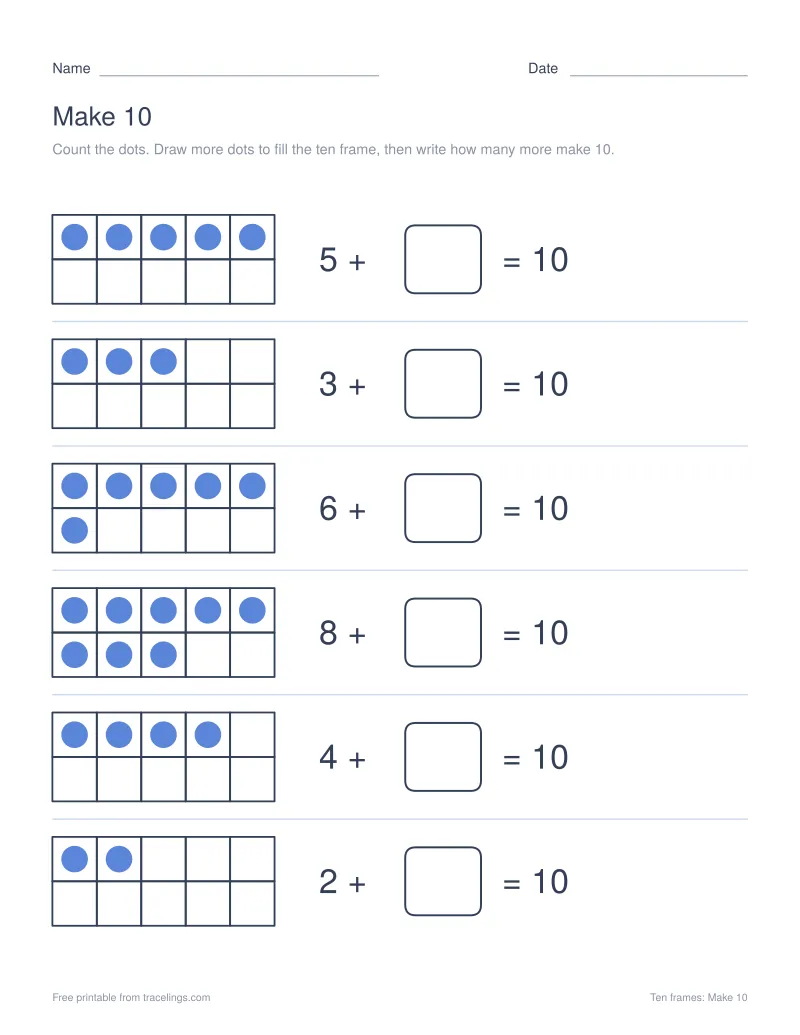
A ten frame printable is the simplest math tool you can keep at home: two rows of five boxes. Kids put one counter or one dot in each box, and the shape does the rest. A full top row is 5, a full frame is 10, and a double ten frame shows the teen numbers as ten and some more. Everything here is made in your browser, so the child's name on the page never leaves your device.
Five kinds of ten frame pages
- Blank ten frames: one big frame to use as a counting mat, a double ten frame for 11 to 20, or six small empty frames to draw in.
- How many?: count the dots in each frame and write the number. Choose 1 to 5, 1 to 10, or 11 to 20 with two frames per problem.
- Show the number: the reverse. Read a number and draw that many dots in an empty frame.
- Make 10: each frame has some dots. Draw the rest, then write how many more make 10 (5 + 5 = 10, 7 + 3 = 10).
- Ten frame addition: blue dots plus orange dots in one frame, then write the sum. Pick within 5, within 10, or sums from 11 to 20.
Using a blank ten frame as a counting mat
Print the one big frame on card stock if you have it. The boxes are large enough for buttons, coins, small blocks or cereal. Say a number and have your child build it, filling the top row from left to right first. Then ask two questions: "How many?" and "How many empty boxes?" The second question is the start of making 10.
Slide the mat into a sheet protector and it becomes a dry erase ten frame. Six small frames on one page work well for dice games: roll, draw that many dots, and see who fills a frame first.
The double ten frame and numbers 11 to 20
Teen numbers are tricky because "fourteen" doesn't sound like "ten and four." A double ten frame shows it. Fill the top frame all the way, then put four in the bottom frame. After a few days many kids stop counting the full frame and say "ten, eleven, twelve..." from there. For writing practice on the same numbers, add a number tracing 1 to 20 page.
Make 10 and ten frame addition in kindergarten
Knowing the pairs that make 10 (1 and 9, 2 and 8, and so on) helps with almost every addition and subtraction problem that comes later. On the Make 10 page, have your child point to each empty box while counting up. On the addition page, the two colors show both numbers at once, and in the 11 to 20 version the orange dots finish the first frame before spilling into the second. That is the same "make a ten" idea in picture form.
Many kids work on numbers to 10 somewhere between ages 4 and 6, and adding within 10 usually comes in kindergarten. Kids develop at different speeds. If you have concerns, ask your child's teacher or pediatrician.
How these fit our homeschool plans
The homeschool preschool curriculum has a ten frame on every Thursday count and color page, and the kindergarten plan uses ten frames through week 21, then moves to adding within 5 and 10. Use these pages for extra practice on the same numbers. For count and color, count and circle, and more or fewer pages, see the pre-K math worksheets.
When ten frame addition feels easy, the kindergarten addition worksheets add picture addition, a number line and subtraction. Every math maker is listed on our kindergarten math worksheets page, with a free sampler.
A 10-minute ten frame routine
- 3 minutes: on the big blank frame, build three numbers with counters. Ask "how many?" and "how many more to make 10?" each time.
- 5 minutes: one worksheet side by side. Do the first problem together out loud, then let your child do the next one.
- 2 minutes: a quick flash game. Fill a frame, cover it, show it for two seconds, and ask how many they saw.