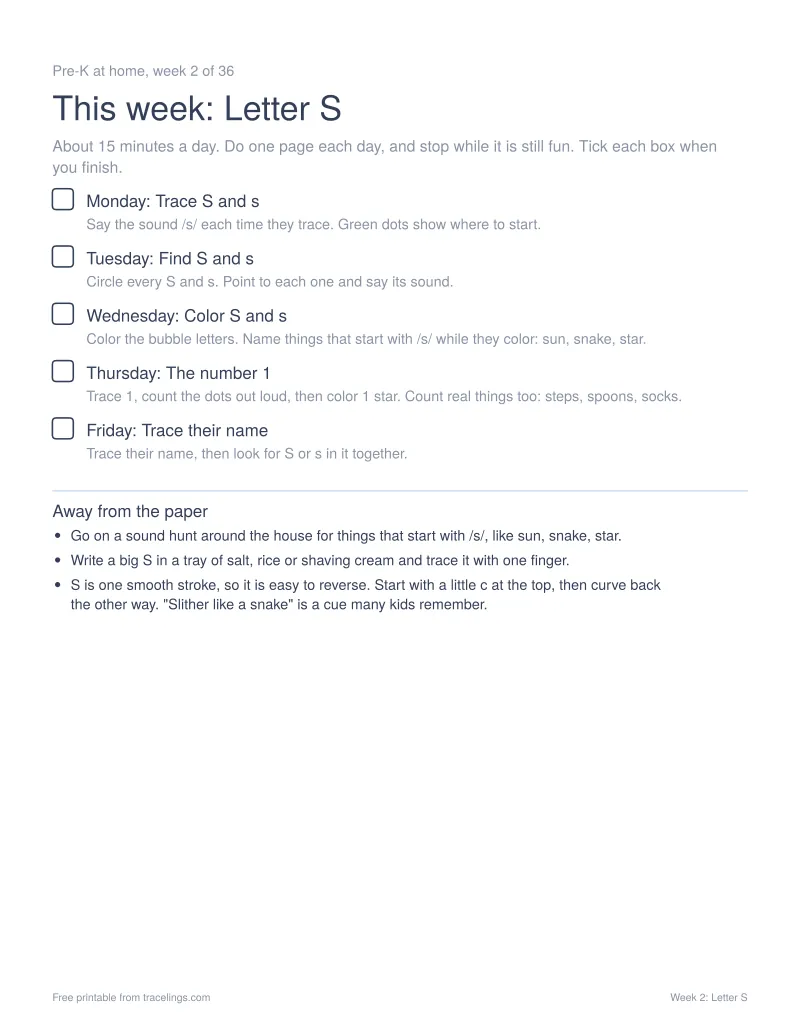
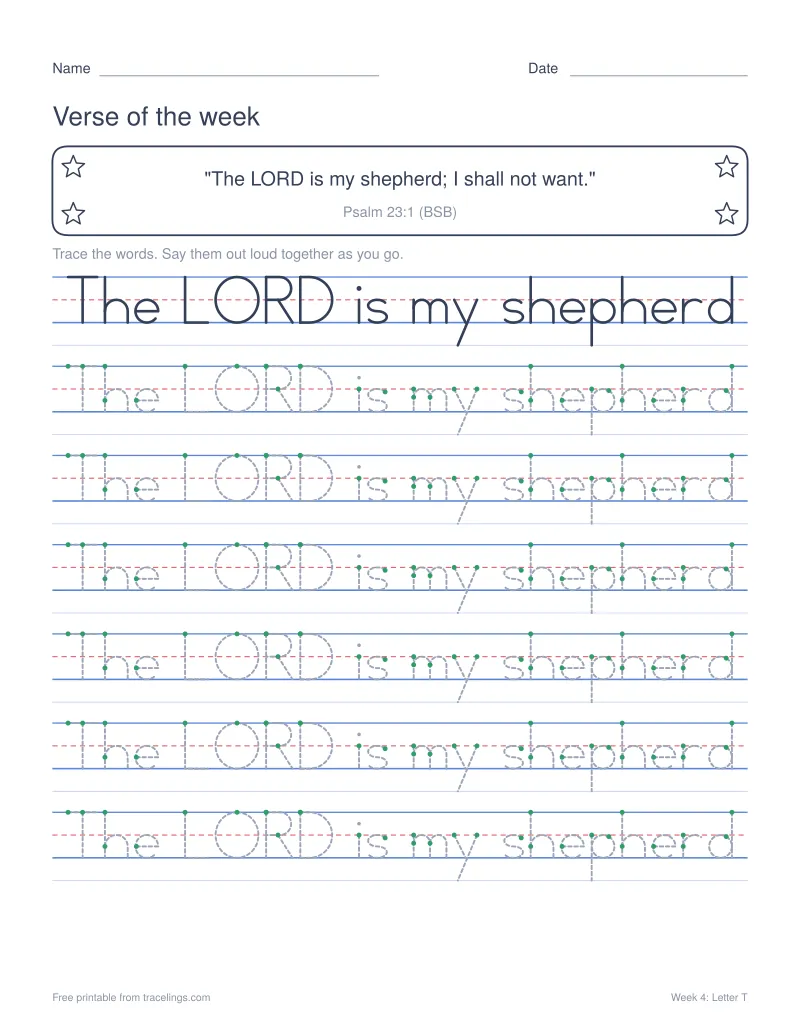
Tracelings at Home is a homeschool curriculum for preschool and kindergarten. Each of the 36 weeks comes as one printable pack made with your child's name: a plan page that tells you what to do each day, then a short page for Monday through Friday. Most days take about 15 minutes, which is plenty at this age.
How to start homeschooling preschool or kindergarten
You don't need a classroom or a box of books to start. Many families begin with four simple steps:
- Check your state's rules. Homeschool laws vary by state. Your state education department or a statewide homeschool group can tell you what is needed where you live.
- Find your child's starting point. Notice what they can do today: name letters, say letter sounds, count to 10, write their name. Our free placement check walks you through it in about 5 minutes.
- Pick a small daily rhythm. 10 to 15 minutes at the table, at the same time each day, plus reading aloud and play.
- Print one week at a time. Print on Sunday, keep the pages in a folder, and repeat a week whenever it needs more time.
Starting with a 3 or 4 year old? Our guide on how to homeschool preschool has a short supply list and a first week you can start on Monday, and our preschool homeschool schedule guide walks through a full day and week. You can also print a free preschool daily schedule with pictures for the fridge.
How a week works
Here's a typical Pre-K week. Kindergarten weeks follow the same rhythm with two letters, word families and sight words.
- Monday: Trace the letter of the week and say its sound.
- Tuesday: A letter hunt: find and circle every capital and lowercase.
- Wednesday: Color the big bubble letters while you name words that start with it.
- Thursday: The number of the week: trace it, count the dots, color that many stars.
- Friday: Trace their own name, then spot this week’s letter in it.
The plan page also lists a few ideas away from the paper, like a sound hunt around the house or writing the letter in a tray of salt. Those count just as much as the worksheets.
What's free and what's in the membership
- Free for everyone: week 1 of each plan, the placement check, and every one-page printable on the site, one page at a time.
- With the membership: all 36 weeks of the Pre-K and kindergarten plans and the faith track, a plan built around each child (up to 4 kids), a new picture book each week, a weekly check-in and a progress report. $14.99 a month or $99 a year.
Want more counting between math days? Our free pre-K math worksheets make ten frame, count and circle, more or fewer and missing number pages for numbers 1 to 20, and our ten frame printables add blank and double ten frames, make 10 and ten frame addition.
Teaching kindergarten at home? All of our free kindergarten math worksheets are on one page with a 6-page sampler, including more or less worksheets, kindergarten addition worksheets, kindergarten subtraction worksheets, mixed addition and subtraction worksheets and read-aloud kindergarten word problems.
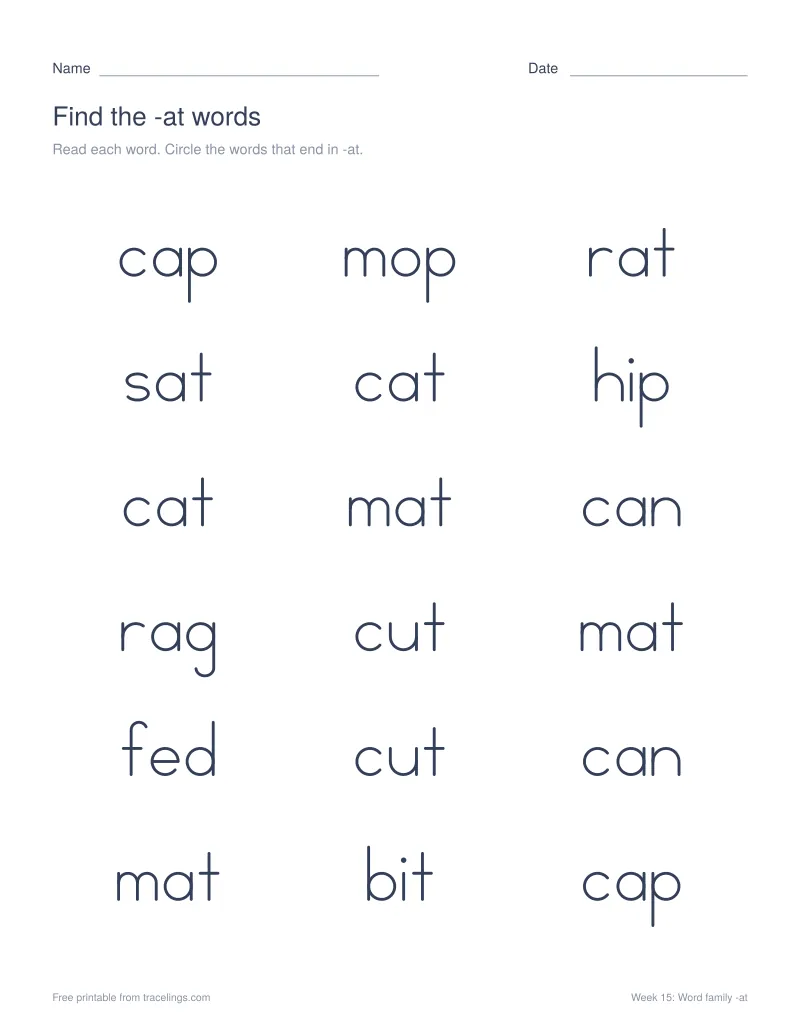
For reading, every short vowel family has its own free word family worksheets (list, tracing, word hunt, sort, a word family house and a slider), starting with the -at word family.
Why the letters aren't in A to Z order
Both plans teach letters in a common phonics order that starts with s, a, t, i, p and n. Those few sounds already make real words (sat, pin, tap), so kids get to read something early. If you'd rather go A to Z, every letter of the week page explains its letter, and our free letter tracing worksheets cover the whole alphabet in order.
What you'll need
- A printer and plain paper. Black and white is fine.
- Crayons or chunky colored pencils, plus a regular pencil for tracing.
- A folder or binder to keep each week's pages together.
- Ten small things to count, like blocks, buttons or crackers.
When to slow down
Kids learn letters and numbers at very different speeds. It's fine to repeat a week, skip a page, or do the hunt with your finger instead of a crayon. If a page brings tears, stop and try again another day. If you have concerns about your child's progress, ask your child's teacher or pediatrician.