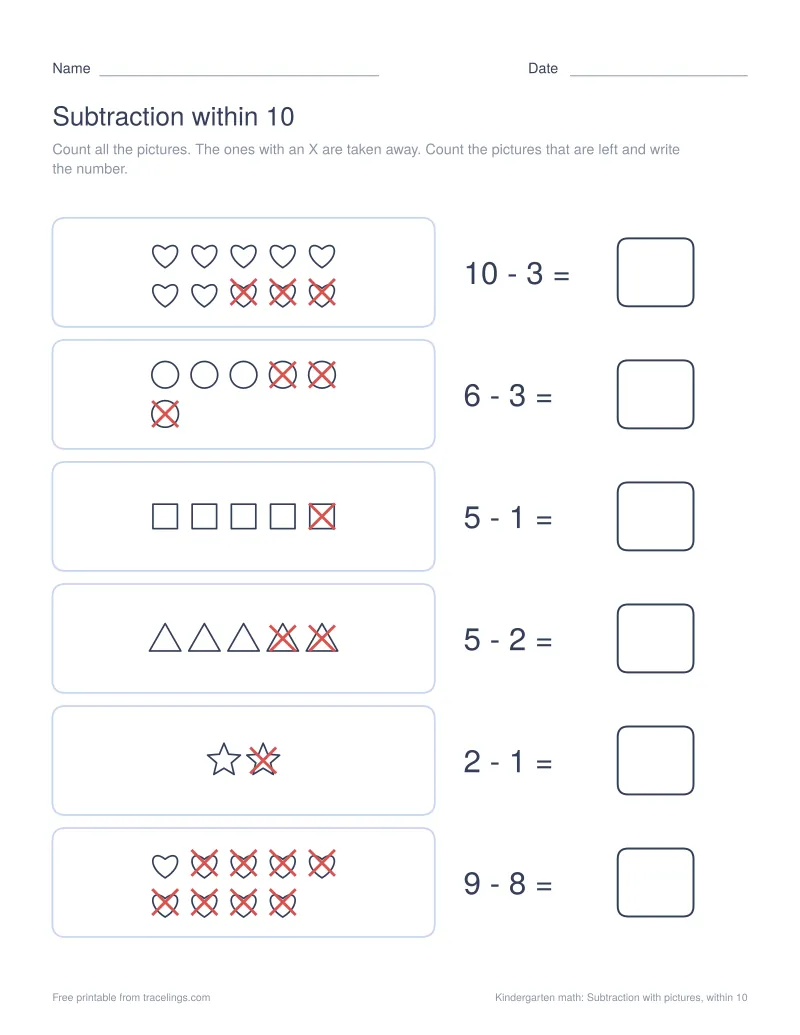
Kindergarten subtraction starts with taking things away: five crackers, eat two, how many are left? These worksheets follow that path, from pictures that are already crossed out to pictures your child crosses out, then a number line, then plain number sentences. Every page is made in your browser with fresh problems, and the child's name on the page never leaves your device.
Four kinds of kindergarten subtraction pages
- Subtraction with pictures: a group of pictures with some already crossed out. Count what is left and write it in the box.
- Cross out and subtract: the same pictures with no X marks yet. Your child reads the number sentence, crosses out that many, and counts the rest.
- Number line subtraction: a number line under each problem with a dot on the first number. Hop back the second number and write where you land.
- Subtraction facts: twelve number sentences, no pictures. Good for practice once the picture pages feel easy.
Kindergarten subtraction worksheets with pictures
Start here. The pictures sit in rows of five, and the ones that were taken away have a red X. Your child only has to count the pictures without an X. Read the number sentence out loud together first: "seven take away three." Saying "take away" before "minus" helps the idea stick, because it matches what is happening on the page.
Once that feels easy, switch to cross out and subtract. Now your child does the taking away. Cross out from the end of the group, so the pictures that are left stay together and are easy to count. Kids who rush often cross out one too many, so have them count the X marks before they count what is left.
Number line subtraction
The number line shows subtraction as counting back. Put a finger on the blue dot, then hop one space to the left for each number you take away, saying the numbers as you go: "nine... eight, seven." Drawing a little arc for each hop helps kids keep track. Counting back is harder than counting on for many kids, so expect this page to take a bit longer than the picture pages.
Within 5, within 10 or within 20?
Within 5 keeps every number at 5 or less, so each problem fits on one hand. It also has a few problems like 3 - 3, where nothing is left. Move to within 10 when your child can do within 5 without counting every picture twice. Last, within 20 is a stretch for kindergarten: it starts from numbers between 8 and 20 and never takes away more than 10.
Many kids take away within 10 with pictures or fingers somewhere between ages 5 and 6, and subtracting without pictures often comes later than adding without them. Kids develop at different speeds. If you have concerns, ask your child's teacher or pediatrician.
Subtraction alongside the kindergarten plan
Our kindergarten homeschool curriculum works on adding within 5 from week 22 and within 10 from week 29. A good fit is one subtraction page a week in those weeks, at the same range as the adding, after your child has done the week's addition page. The kindergarten addition worksheets come in the same three ranges, so you can print one of each and talk about how they match. After a few weeks of both, the addition and subtraction worksheets for kindergarten mix the two signs on one page.
More kindergarten math
Ten frames make subtraction from 10 easy to see, and the ten frame printables include blank frames to use with counters. Every math maker is listed on our kindergarten math worksheets page, with a free 6-page sampler to print.
A 10-minute subtraction routine
- 3 minutes: act out two problems with toys or snacks. Line up six cars, drive two away, and ask how many are still parked.
- 5 minutes: one worksheet side by side. Do the first problem together, then let your child do the next two alone.
- 2 minutes: a finger game. Hold up five fingers, fold some down, and ask how many are still up.