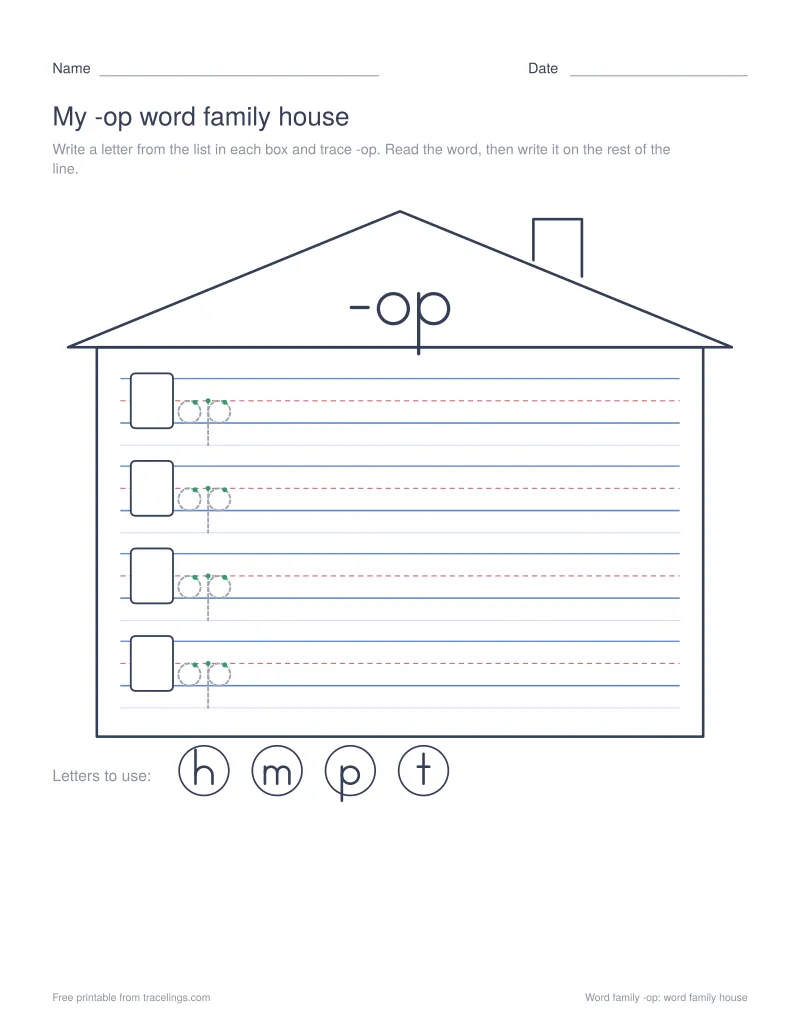
The -op word family is the group of short words that end in -op: hop, mop, pop and more. Change the first letter and you get a new word, so a child who can read one -op word can read the whole set. These worksheets practice that one move from six angles. Everything is made in your browser, so your child's name never leaves your device.
The -op word family list
Every word here is a short o word your child can sound out letter by letter.
- hop
- mop
- pop
- top
Sentences to read: "Hop to the top." "Mop it up." "The top can pop." They mix -op words with early sight words, so the reading feels like a real book.
Sight words: No -op words are on the Dolch lists. The sentences use "to," "the" and "up."
For later: stop, shop, drop and flop also end in -op, but they have two or more letters before the vowel, like the st in stop. Save them until the short words feel easy.
How to teach the -op word family
- Say the ending. Write -op on a card. Read it together a few times until your child says it quickly.
- Add a first sound. Hold the letters h, m, p, t in front of the card one at a time. Say the sound, then blend it with -op.
- Read the list page. Your child colors a box each time they read a word, three readings per word.
- Trace and build. Do the tracing page, then the word family house: write a first letter in each box, trace -op, and read the word.
- Check the ending. The word hunt mixes in words like cot and dot, so your child has to look at the end of every word, not only the first letter.
Away from the paper: Hop on one foot for each -op word your child reads. Ten hops means ten words.
The -op or -ot word sort
The sort page puts four -op words and four -ot words in a box. Your child reads each one and writes it under the right ending. Both families share the short o sound, so the only clue is the last letter. That is the skill that turns guessing into reading. Tap New words for a fresh mix.
Where -op fits in the kindergarten plan
In our kindergarten homeschool curriculum, -op is week 25. That week's pack reads the -op words on Monday, has a word hunt on Tuesday and adds the sight words he and into. Week 28 is the short o review, which mixes -op, -ot, -og in one hunt. Use these pages for extra practice in the same week, or to go back to -op later.
Kids learn to read at different speeds, and plenty need a family more than once. Repeat a page whenever you like. If you have concerns about your child's reading, ask your child's teacher or pediatrician.
A 10-minute -op routine
- 2 minutes: read the -op list out loud together, then have your child read it alone.
- 5 minutes: one worksheet. Monday the list, Tuesday tracing, Wednesday the hunt, Thursday the house or slider, Friday the sort.
- 3 minutes: read one sentence from the list page, then find a -op word in a book you already own.