These pre-K math worksheets cover the counting skills most preschool programs work on: counting a group of things, matching a number to a group, comparing groups and putting numbers in order. Each page is made fresh in your browser, so you can print a new set of problems whenever your child is ready for another round.
Six kinds of preschool math worksheets
- Count and color: trace one number, count the dots in a ten frame, then color that many stars. Pick any number from 1 to 20.
- Find the number: a key at the top shows one number and that many dots. Below are six boxes of shapes. Kids circle every box with that many, then write how many boxes they circled. The other boxes hold one or two more or fewer, so each box has to be counted.
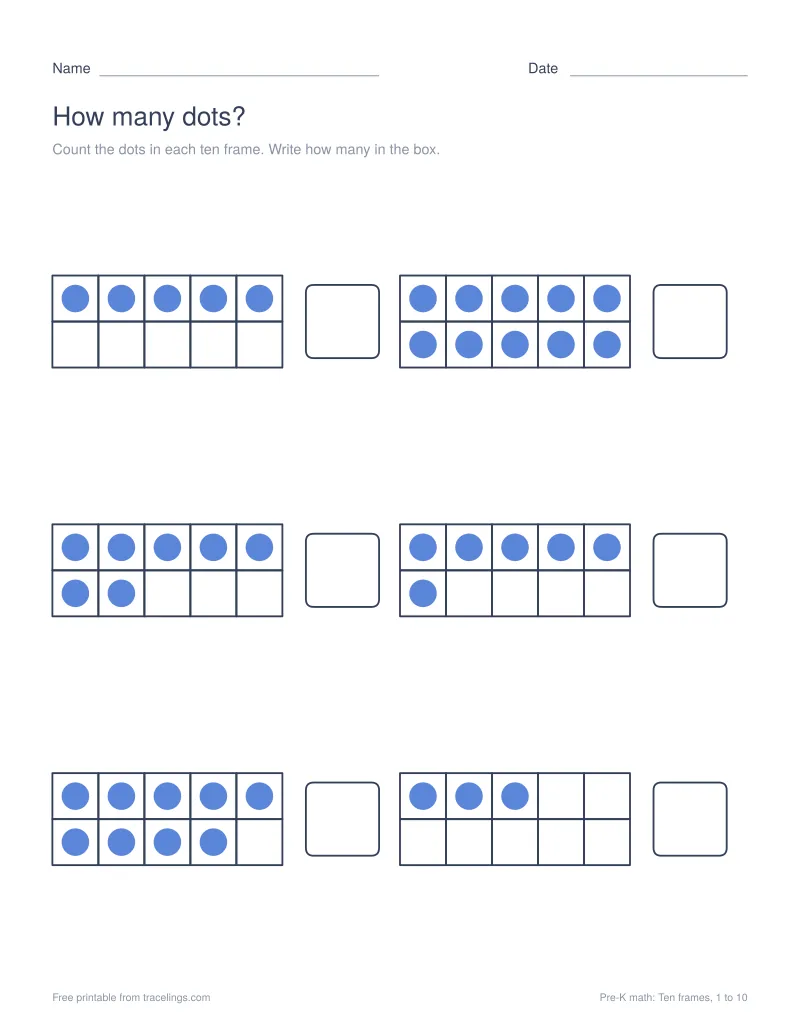
- Ten frames: count the dots and write how many. For 1 to 20 the page uses two frames side by side, so kids see 10 and some more.
- Count and circle: count a row of shapes and circle the matching number from three choices. Shapes sit in groups of five, which makes them easier to count.
- More or fewer: two boxes of shapes on each row. Circle the box with more, or switch the page to fewer.
- Missing numbers: rows of five numbers in order with a blank box or two. Read the row out loud and write the number that fits.
Which numbers to start with
Start with 1 to 5 if your child is still learning to count a small group. Move to 1 to 10 when they can count five things without skipping or counting one twice. Save 1 to 20 for kids who count to 10 easily and are curious about bigger numbers.
Many kids count to 10 with objects somewhere between 3 and 5, and the teen numbers often take longer. Some kids recite numbers well before they can count objects, and that is normal. If you have concerns, ask your child's teacher or pediatrician.
Why ten frames work so well in pre-K
A ten frame is two rows of five boxes. Kids quickly learn that a full top row is 5 and a full frame is 10, so they start to see amounts without counting every dot. That habit makes adding and taking away much easier in kindergarten. If your child counts each dot one by one at first, that's fine. Point to the full row and say "that's five" each time.
For a blank ten frame to use with counters, a double ten frame for the teen numbers, or make 10 pages, see our ten frame printables and worksheets.
Make it hands-on first
- Put a small cracker, a button or a coin on each shape before counting. Count as each one goes on.
- Draw a ten frame on paper and fill it with toy cars or blocks. Ask how many, then how many more to make 10.
- For more or fewer, make two piles of grapes and let your child eat the extra ones to make the piles match.
- For number order, count steps on the stairs, then start from a number other than 1.
Writing numbers is a separate skill from counting. If writing the answer is hard, let your child say it and you write it, or try a number tracing worksheet for 1 to 10 on another day. For teen numbers, the number tracing 1 to 20 page has every number in order.
How these fit the preschool plan
Thursday is math day in our homeschool preschool curriculum. Each week has a number of the week, and that day's page is the count and color page you can make here. The first 20 weeks work through 1 to 10, and later weeks move on to 11 to 20. When your child wants more math that week, tick the extra math page box in the weekly pack to add a find the number page for the same number, or make a ten frames or count and circle page here.
Ready for the next step? Our kindergarten math worksheets pick up from here, with more or less worksheets that compare numbers as well as groups, and kindergarten addition worksheets within 5 and 10.
A simple 10-minute math routine
- 2 minutes: count something real together, like spoons at dinner or socks in the basket.
- 5 minutes: do one worksheet side by side. Count the first row out loud together, then let them try the next one.
- 3 minutes: one hands-on idea from the list above, using the same numbers as the page.