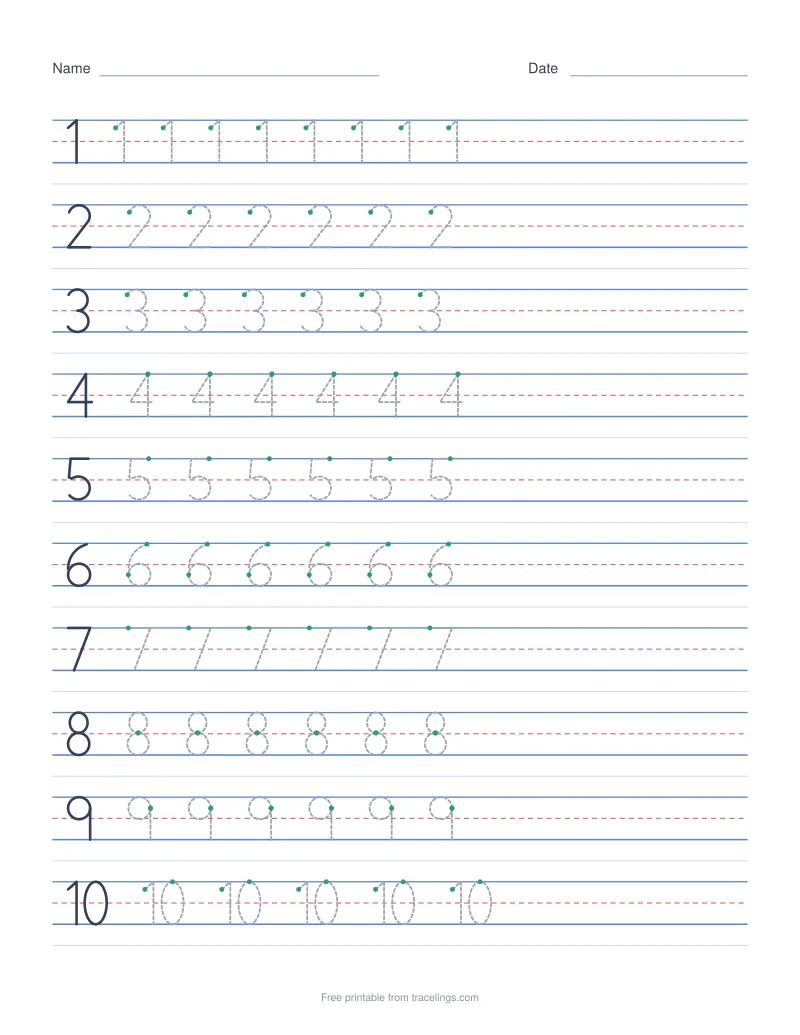
These free number tracing 1-10 worksheets put every number from one to ten on handwriting lines, in the order your child counts them. Each row starts with a solid number to look at, then dotted copies to trace, with green dots where every stroke begins. Choose trace only, or leave space at the end of each row so they can write the number on their own.
How to use the 1-10 tracing sheet
- Count, then trace. Before each row, have your child count out that many small things, like buttons or cereal. Then trace the number that matches.
- Start at the green dot. Every number has a set starting point. Starting there each time is what stops 3, 7 and 9 from coming out backwards.
- Trace slowly, then write. On the trace-then-write sheet, the empty space at the end of each row is for writing the number without help.
- Reuse it. Slip the page into a sheet protector and trace with a dry-erase marker for a week of practice from one print.
Counting games to go with it
- Number hunt: Call out a number from the sheet and have your child find that many toys before tracing the row.
- Roll and trace: Roll a die (or two for 7 to 10), count the dots, then trace that row.
- Fingers up: Hold up fingers and let your child find and trace the matching number. Then swap roles.
Number formation tips
Most numbers start at the top line and move down. A few need extra help: 5 starts with the flat line across the top, then drops down and curves around its belly; 8 is a small circle stacked on a bigger one; and 10 is the first two-digit number, so point out that it is a 1 and a 0 side by side. Short, daily practice works better than long sessions. Five minutes is plenty for a three or four year old.
Is one number giving your child trouble? Each digit has its own sheet with stroke-by-stroke steps:
- 0 tracing worksheet
- 1 tracing worksheet
- 2 tracing worksheet
- 3 tracing worksheet
- 4 tracing worksheet
- 5 tracing worksheet
- 6 tracing worksheet
- 7 tracing worksheet
- 8 tracing worksheet
- 9 tracing worksheet
Frequently asked questions
What age are number tracing 1-10 worksheets for?
Most children are ready somewhere between ages 3 and 5, once they can hold a crayon or chunky pencil and count a few objects. Preschoolers often start with the bigger one-per-row layout, and kindergartners can usually manage all ten numbers on one page.
Are these number tracing sheets free?
Yes. Add your email once and every sheet on that device is free to print, up to 7 downloads a day, with no password.
Should my child learn to write 1 to 10 in order?
Counting order is the easiest way to practice once your child knows the digits, because it ties each number to counting. If a few numbers are hard, such as 2, 5 or 8, give those their own single-number sheet first and come back to 1 to 10 afterward.
Why does my child write some numbers backwards?
Reversed numbers are very common while kids are learning, especially 2, 3, 7 and 9. Starting every number at the green dot helps, and so does saying the movement out loud. Most reversals fade with steady practice.
What is the difference between the two layouts?
One page puts all ten numbers on a single sheet, one number per row, so it is quick to print and finish. Bigger numbers gives each number a full row at the line size you choose, which spreads 1 to 10 over two or more pages for younger kids.
Keep going
When 1 to 10 feels easy, move on to the number tracing 1-20 worksheets for the teen numbers. You can also browse all the number tracing worksheets, practice letters with letter tracing, or make a name tracing worksheet with your child's name.